Creating Investment Solutions - We’re delighted to announce that the BNP Global Equity Bond 2 matured on the 08th of December 2025, delivering an impressive gross return of 15.525% over 18 months — equivalent to 10.35% per annum. Click here for further details. Over the past five years, our 49 maturities have generated a total gross return of €39 million for our clients, achieving an average annual return of 12.75% over an average term of 22 months. Creating Investment Solutions - We’re delighted to announce that the BNP Global Equity Bond 2 matured on the 08th of December 2025, delivering an impressive gross return of 15.525% over 18 months — equivalent to 10.35% per annum. Click here for further details. Over the past five years, our 49 maturities have generated a total gross return of €39 million for our clients, achieving an average annual return of 12.75% over an average term of 22 months.

WEEKLY MARKET REVIEW

Stay Informed with Our Seaspray Private Weekly Financial Market Review

Get the latest insights on global financial markets with our Weekly Market Review. In it we discuss the key financial headlines from the U.S, Europe, UK, Ireland, and Asia-Pacific, along with in-depth analysis of major asset classes, including:

Equities – U.S, Europe, and UK market trends
Bonds – Interest rate movements and fixed-income insights
Commodities – Oil, gold, and other key market drivers

Stay ahead of market trends with our expert insights. Read the latest update now!

Weekly Market Review: 19th January 2026

The Week in Numbers

Equity Markets

Equity IndicesValueWeekly ChangeYTD Change
S&P 5006,940.01-0.15%+1.38%
NASDAQ23,515.39-0.46%+1.18%
EuroStoxx506,029.45+0.65%+4.11%
EuroStoxx600614.38+0.86%+3.75%
FTSE 10010,235.29+1.16%+3.06%
ISEQ13,070.26+0.39%-0.22%

Central Bank Interest Rates

Interest RateCurrent RateDirectionRate Change
FED3.75%0
ECB2.15%0
BOE3.75%0

Government Bonds

Fixed IncomeYieldWeekly ChangeYTD Change
US 10YR4.231+1.44%+1.88%
US 2YR3.599+1.67%+3.75%
German 10YR2.838+0.45%-0.84%
UK 10YR4.401+0.55%-1.63%
Irish 10YR2.942-1.84%-2.85%

Foreign Exchange Currency Movements

FXValueWeekly ChangeYTD Change
EUR/USD1.159-0.28%-1.26%
EUR/GBP0.866-0.14%-0.59%
GBP/USD1.338-0.14%-0.68%

Key Events

Economics

  • 19/01/2026 – China GDP Data
  • 21/01/2026 – UK Inflation Data
  • 22/01/2026 – US Core PCE Data
  • 22/01/2026 – US GDP Data

Earnings

  • 20/01/2026 – Netflix
  • 21/01/2026 – J&J, Charles Schwab
  • 22/01/2026 – Visa, P&G, LVMH, GE Aerospace
Critical Minerals in Focus: Gold, Silver, Copper, and Global Supply Dynamics
In our latest Seaspray Private financial data insight we examine where the world’s largest mineral reserves are located and which countries are best positioned to benefit from increased production and long-term demand. Drawing on global reserve and production data, we explore the strategic importance of minerals essential to modern technologies, renewable energy infrastructure, and data centres.

Stay Informed with Our Seaspray Private Weekly Financial Market Review

Get the latest insights on global financial markets with our Weekly Market Review. In it we discuss the key financial headlines from the U.S, Europe, UK, Ireland, and Asia-Pacific, along with in-depth analysis of major asset classes, including:

Equities – U.S, Europe, and UK market trends
Bonds – Interest rate movements and fixed-income insights
Commodities – Oil, gold, and other key market drivers

Stay ahead of market trends with our expert insights. Read the latest update now!

FINANCIAL HEADLINES

United States

In US economics, the final inflation reading of 2025 was released last week, with the rate remaining at 2.7% in December. This was in line with market expectations and provided a welcome boost to markets, signalling that tariffs had not yet filtered through to the wider economy and that inflation remained contained. Energy prices eased in December, with petrol prices falling by 3.4% compared with a rise of 0.9% in November. Prices accelerated, however, for food, which rose by 3.1% compared with 2.6% in November, and for shelter, which increased by 3.2% compared with 3.0% in November. The path forward for interest rates in 2026 remains unclear, though consensus points to between one and two cuts before year end.

Elsewhere, exports of non-monetary gold — meaning gold not destined for central banks — reached a record towards the end of 2025, with US exports totalling $17.1bn in October. This is significant given that the average monthly export value over the past 15 years has been between $1bn and $3bn, highlighting the unprecedented level of demand for gold.

Europe & UK

In Europe, the German economy expanded on a full-year basis for the first time since 2022, growing by 0.2% in 2025. Expectations are high that the increased fiscal spending announced by Chancellor Friedrich Merz will lead to stronger growth across the German economy.

In the UK, monthly GDP data signalled that the economy grew by 0.3% in November, beating all forecasts and recording the strongest growth rate since June 2025. This represented a sharp rebound from October’s contraction of 0.1% and was driven by a recovery in the services sector, which expanded by 0.3% in November after contracting by 0.3% in October.

Ireland

The National Treasury Management Agency (NTMA) raised €5bn through the sale of a new 10-year benchmark bond, covering more than 40% of the State’s annual funding requirement. The bond will mature in June 2036 and carries a yield of 3.145%. The NTMA plans to raise between €10bn and €14bn in 2026, and, in a sign of Ireland’s strong economic position, more than €43bn in orders were received for the new issue.

Asia-Pacific

In Japan, Prime Minister Sanae Takaichi is expected to announce a snap election in February, betting on her strong popularity to regain a majority for the Liberal Democratic Party. Japanese stock indices surged on the news, reviving the so-called “Takaichi trade”, which reflects her pro-business, expansionary agenda and her resistance to higher interest rates. In November last year, Takaichi unveiled a $135bn stimulus package aimed at helping households cope with rising electricity and gas prices. It was the largest such package since the Covid pandemic.

In China, key trade data for the world’s largest export market were released last week. The country’s trade balance — the difference between exports and imports — stood at $114bn in December, while for 2025 as a whole it reached an unprecedented $1.18tn, the largest surplus China has ever recorded. Exports rose by 5.5% in 2025 compared with 2024, driven by the impact of US tariffs and by Chinese producers shifting their focus from the US to other regions, including Europe and South-East Asia.

ASSET CLASS REVIEW

Equities

In the United States, markets rose cautiously at the start of last week after news that the Department of Justice had issued subpoenas to Jerome Powell and other senior Federal Reserve officials over the handling of the restoration of Fed buildings. The move was widely interpreted as a direct challenge to the Fed’s leadership by the Trump administration, which has been openly critical of the current trajectory of US interest rates. Markets also reacted to President Trump’s call for credit card interest rates to be capped at 10% for one year, which sent shares in Visa, Mastercard and other financial stocks lower on Monday. Despite this, both major indices moved higher as investors looked past the subpoenas and focused on the start of the first earnings season of 2026. Markets also largely shrugged off the President’s announcement of 25% tariffs on countries trading with Iran, including China and India, as the uncertain geopolitical backdrop suggested the measures may prove short-lived. Midweek, as tensions surrounding Iran briefly escalated, the President softened his rhetoric on potential US involvement, which was welcomed by investors. He also announced 25% tariffs on certain chip exports from Nvidia and AMD, allowing Washington to take a share of sales of AI processors to China. However, after remarks on Friday stating he wished to keep Kevin Hasset in his current role rather than a potential Federal Reserve chair, markets dropped as expectations fell regarding dovish Fed policy in 2026.

In earnings, the largest US financial institutions reported results for the fourth quarter of 2025, including JPMorgan, Goldman Sachs, Morgan Stanley and Citigroup. JPMorgan, the largest bank in the US and globally by market capitalisation, reported stronger-than-expected results, beating revenue estimates by 1.6% with revenues of $46.77bn. Profits fell by 7% to $13.03bn, largely due to the acquisition of the Apple Card portfolio. Citigroup posted mixed results, missing revenue forecasts by 3.75% with revenues of $19.87bn. This was largely due to the sale of AO Citibank in Russia, which resulted in a $1.1bn loss. Strong performances in investment banking and wealth management partially offset weaker results in its markets division. Goldman Sachs and Morgan Stanley also reported solid earnings, supported by strong equity trading and investment banking activity.

In corporate news, the high-profile Warner Bros. Discovery takeover battle took a new turn after Paramount, one of the companies seeking to acquire Warner, filed a lawsuit over its agreement to sell its studios to Netflix in a deal valued at $82bn. Paramount, led by David Ellison, son of Oracle founder Larry Ellison, had previously made several offers to acquire Warner, including bids exceeding $100bn, and argued that its proposal would face fewer antitrust concerns than a deal with Netflix. Elsewhere, OpenAI agreed a $10bn deal with Cerebras Systems, under which it will secure 750 megawatts of computing capacity. Cerebras develops specialised chips designed to enable AI inference at speeds significantly faster than those of market leaders Nvidia and AMD. For the week, the S&P 500 and Nasdaq closed lower, down -0.15% and -0.46% respectively.

In Europe, equity markets reached new highs on three separate occasions last week. The Euro Stoxx 50 and STOXX 600 both hit record levels on Monday evening, Tuesday afternoon, and again on Thursday morning, supported by positive investor sentiment, encouraging US inflation data and easing geopolitical risks. Markets also received a boost on Thursday from strong earnings at Taiwan Semiconductor Manufacturing Company (TSMC), a firm that underpins much of the global AI ecosystem.

In corporate news, Ørsted, the Danish-based wind energy developer, secured a major victory after a US court ruled that it could continue construction at its flagship Revolution Wind project in New York, despite its lease having been suspended by the Trump administration in late December. Ørsted shares rose by more than 6% on Tuesday following the decision, providing a welcome boost for the company, which raised $9bn in a rights issue last October to ease cash flow pressures linked to its suspended US projects. For the week, the Euro Stoxx 50 and the STOXX 600 closed 0.65% and 0.86% higher respectively.

In the United Kingdom, the FTSE 100 reached new record highs last week, supported by strong gains in the mining, energy and healthcare sectors. The index rose by 0.5% on Wednesday to close at 10,184, with Glencore climbing almost 3% and Rio Tinto gaining 1.9%. The two companies are currently in merger talks, which, if completed, would create the largest mining company in the world. Glencore first approached Rio Tinto about a merger in late 2024; however, it is now Rio that is actively pursuing a deal. Rio Tinto is the world’s largest iron ore producer, while Glencore produces more than 60 commodities across operations in over 30 countries. Although declining oil and mineral prices weighed on the index later in the week, the FTSE 100 still recorded a weekly gain of 1.16%.

Bonds

Global bond yields rose modestly last week, with the US 10-year Treasury yield rising to 4.23% on Friday. US inflation for December came in at 2.7%, unchanged from November, while initial jobless claims for the week ending 10 January were significantly lower than expected at 197k, compared with forecasts of 215k. Together, these data points reduced the immediate pressure on the Federal Reserve to cut interest rates, pushing yields higher. In the UK, the 10-year gilt yield rebounded from a one-year low on Wednesday evening to 4.39% following stronger-than-expected GDP data, which prompted markets to scale back expectations for interest rate cuts.

Commodities

Oil prices were volatile last week, rising to their highest level since October as tensions increased over potential US involvement in Iran. The country exports almost 90% of its oil to China, meaning any disruption to supply could have a significant impact on the Chinese economy. Iran’s position along the Persian Gulf — and in particular the Strait of Hormuz, through which an estimated 20% to 30% of global oil supply passes each day — also contributed to higher prices. However, after President Trump de-escalated tensions on Thursday morning, prices fell by around 3%. Brent crude ended the week at $64.13 per barrel, while WTI closed at $59.44.

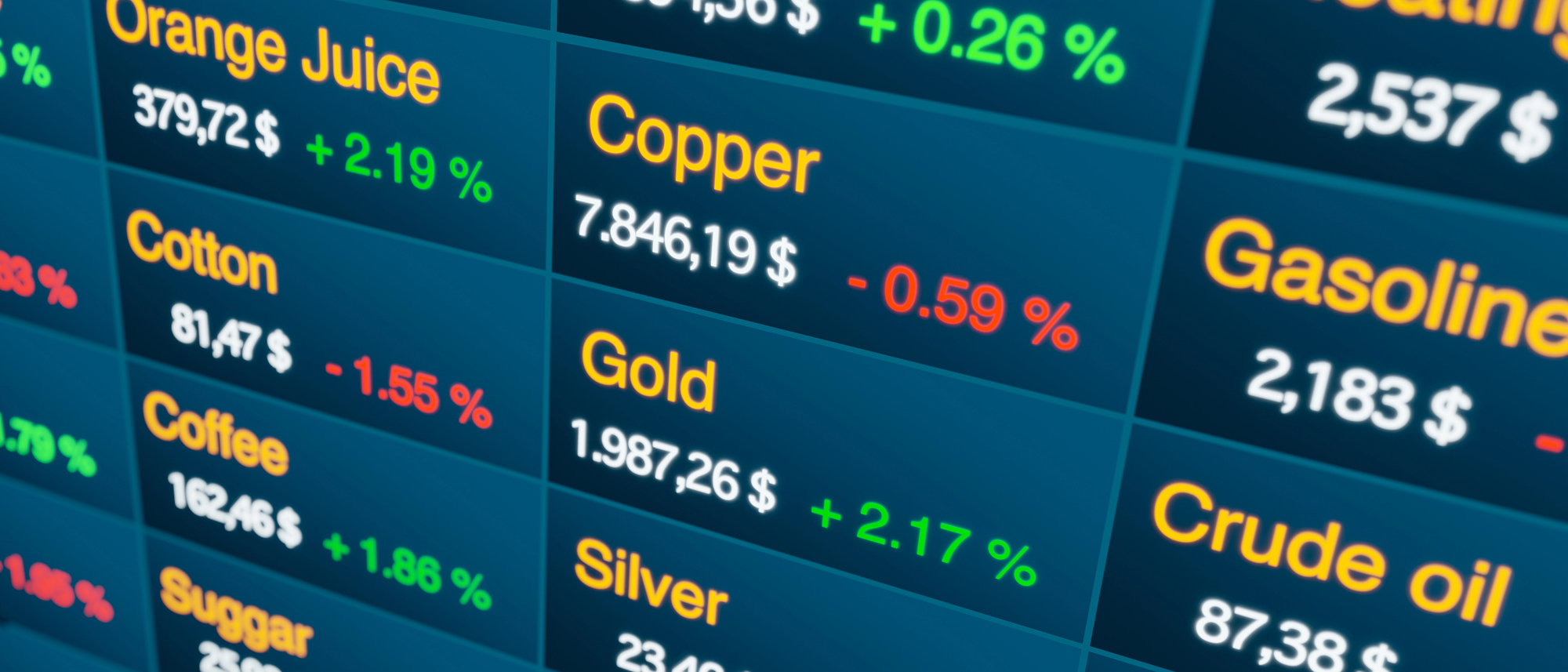
In metals, gold and silver prices retreated during the week as geopolitical tensions eased and US economic data pointed to a resilient labour market and stable inflation. These factors weighed on gold, while silver also declined after President Trump refrained from imposing tariffs on critical minerals. Gold closed at $4,594 per ounce, up 2.6% on the week, while silver finished at $89 per ounce, up 15% over the same period.

MORE INSIGHTS